
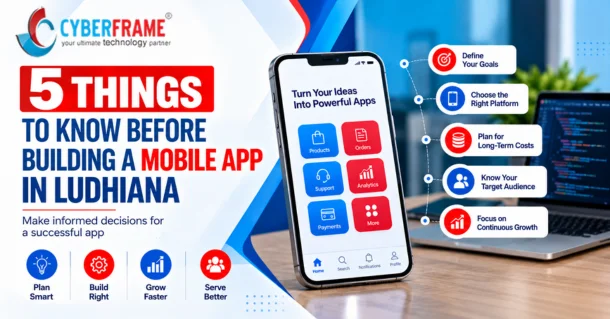
5 Things to Know Before Building a Mobile App in Ludhiana
Walk through any industrial area in Ludhiana and you'll notice something. The same businesses that have been running on phone calls, WhatsApp groups and Excel sheets for years are now asking one question: should we build an app? It's a fair question, and honestly, a lot of business owners jump into it without really knowing what they're signing up for.
If you're in that boat, here's the thing. Mobile App Development Ludhiana has picked up a lot in the last couple of years, but not every business that builds an app actually needs one, and not every app that gets built actually works out. So before you call up a developer, here are five things worth sitting with first.
1. Figure Out What You're Actually Trying to Fix
This is the part everyone skips. A business owner sees a competitor with an app, panics a little, and calls a developer the same week. No real problem in mind, just a vague sense that they're falling behind.
That's backwards. Ask yourself what's actually broken. Maybe your customers keep calling to check order status and it's eating up your staff's time. Maybe repeat buyers have no reason to come back because there's no loyalty system in place. Whatever it is, write it down before you talk to anyone. An app built around a real, specific problem gets opened again and again. An app built out of FOMO gets downloaded once and forgotten in a folder somewhere. If you're serious about Mobile App Development Ludhiana, bring your problems to the table, not just a features wishlist you copied from someone else's app.
2. Native, Hybrid, Web App, They're Not Interchangeable
Here's something that trips up a lot of first-timers. People think "app" means one thing, one process, one price. It doesn't work that way.
Native apps are built specifically for Android or iOS, and they tend to feel snappier because they're working directly with the phone's hardware. Hybrid apps share one codebase across both platforms, which usually means lower cost and a faster launch. Then there's the plain web app, which just runs in a browser and skips the download step entirely.
None of these is automatically "the right one." A small shop selling readymade garments might do fine with a lightweight hybrid app. A logistics-heavy manufacturing unit tracking shipments in real time might actually need native performance to avoid lag. Ask whoever you're working with to walk you through the tradeoffs in plain language, not jargon, before you sign anything.
3. The Build Cost Is Not the Whole Bill
Nobody warns you about this one enough. You pay for the app, it launches, and you think you're done. Then six months later there's a bug, or Apple pushes an update that breaks something, or you want to add a feature customers keep asking for. And suddenly you're paying again.
Realistically, plan for 15 to 20 percent of your build cost every year just for upkeep. Hosting, security patches, app store fees, small fixes, all of it adds up. Skip this and your app slowly rots, gets buggy, and customers stop trusting it. At Cyberframe, we actually sit down with clients before anything gets built and lay out the full cost picture, not just the launch number, so there's no awkward surprise call three months in.
4. Local Context Matters More Than People Think
An app built for a Ludhiana business and an app built for a Mumbai business shouldn't look the same, even if they're technically doing the same job. Payment habits are different. Internet speeds vary block to block. Even the language customers are comfortable with changes.
A developer who's actually spent time understanding local buying behavior will design something that fits how your customers actually act, instead of just copy-pasting a template that worked somewhere else. That's a big part of why businesses here keep coming back to teams that get Mobile App Development Ludhiana from the ground level, not just the coding side of it. Cyberframe has worked with enough exporters, retailers and service businesses in this city to know that "generic" rarely converts.
5. Launch Day Is the Start, Not the Finish Line
This is probably the most common misread. Owners treat the app store listing like a finish line. It's not. It's closer to opening day at a new shop, you've just unlocked the door.
Once it's live, you need to actually watch how people use it. What screens do they drop off on? What features never get touched? What are people complaining about in reviews? Apps that get updated based on real usage tend to hold onto users. Apps that get left alone after launch quietly bleed users, usually without anyone noticing until it's too late. Treat it as something ongoing, not a box you tick once.
Conclusion
None of this is complicated, but it's easy to skip when you're excited to just "get an app built." Know the problem first. Understand which type of app actually fits your business, not the flashiest option. Budget for the years after launch, not just the build. Work with people who understand how Ludhiana businesses actually operate. And don't disappear once it's live.
Get these five right and you're already ahead of most businesses that jump in without thinking it through. If you want to talk through what this could look like for your business specifically, that conversation is worth having before you write a single line of code.
FAQ
How much does it cost to build a mobile app in Ludhiana?
It really depends on features and complexity. A simple starter app costs a lot less than something custom-built with advanced functionality, so get a clear scope written down first if you want an accurate number.
How long does it take to build an app?
A basic app usually takes 6 to 10 weeks. Anything more complex, with custom features baked in, can stretch to 3 to 6 months.
Should I build for Android, iOS or both?
Most local businesses start with Android since that's where the bulk of their customers already are, then add iOS later once there's demand for it.
Do I need an app, or would a website be enough?
If customers need quick repeat access, push notifications or offline functionality, an app usually wins out. If you just need visibility and basic information sharing, a website might genuinely be enough for now.
How do I maintain my app after launch?
Set aside a yearly budget for updates and bug fixes, and actually pay attention to user feedback instead of letting it pile up unread.